As AI reshapes the C-suite, the most effective leaders are those who combine technological fluency with deeply human qualities. Explore how human-centric leadership is becoming the defining edge in a tech-driven era.
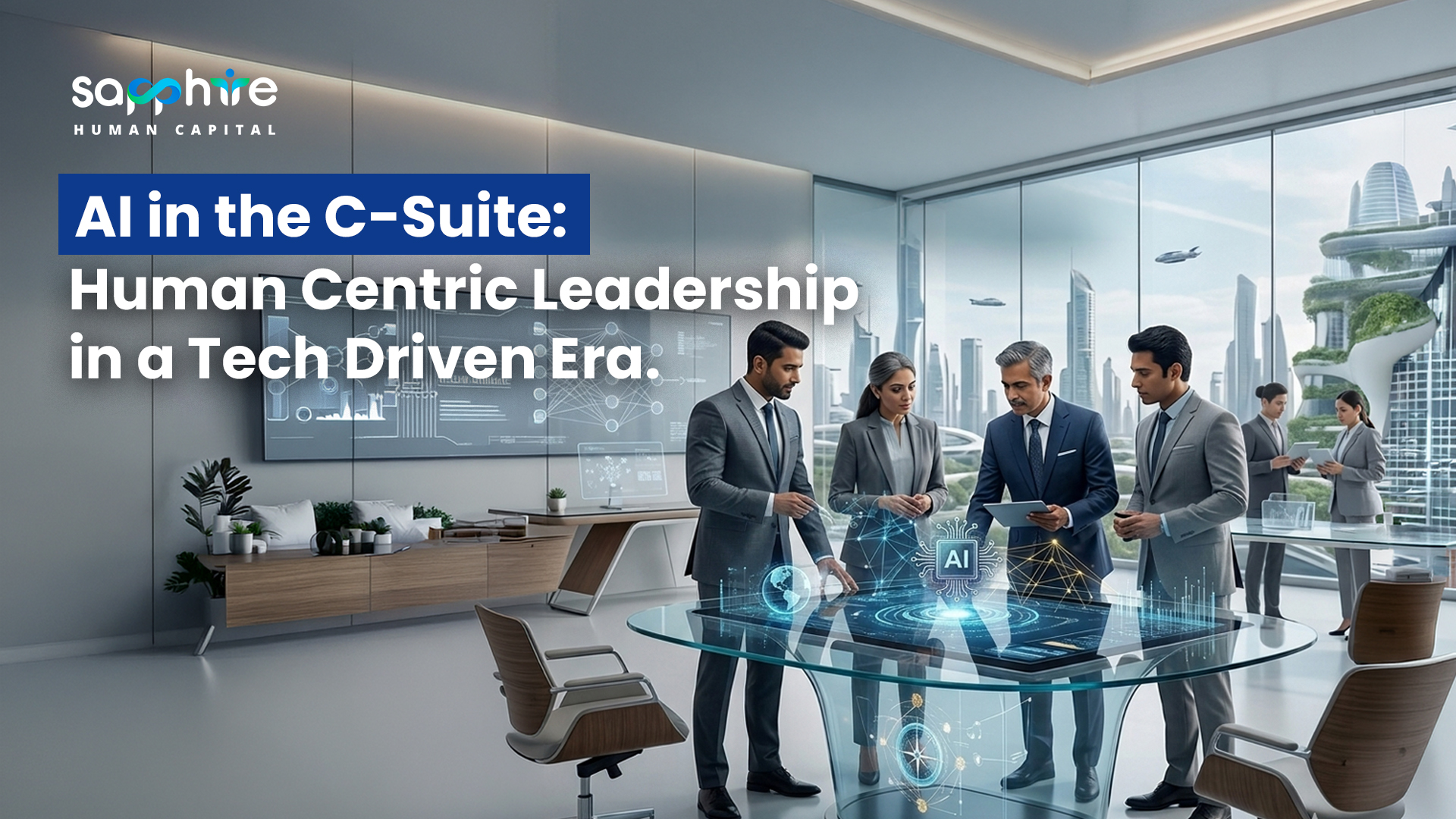



Artificial intelligence is no longer a future-facing concept in boardrooms. It is an operational reality reshaping how organisations think, decide, and lead. Across industries in India and globally, AI tools are automating processes, augmenting decision-making, and transforming the expectations placed on senior leadership. Yet, as technology becomes more deeply embedded in strategy and execution, a quiet but powerful counterforce is emerging: the renewed centrality of human qualities in leadership.
The most effective C-suite leaders of this era are not simply those who understand technology best. They are those who combine technological fluency with emotional intelligence, strategic empathy, and a deeply human approach to organisational culture. This is the defining tension — and opportunity — of leadership in a tech-driven era.
How AI Is Changing the C-Suite Landscape
The arrival of AI at the executive level is fundamentally altering the scope of every C-suite role. CEOs are now expected to understand the strategic implications of large language models and automation. CFOs are leveraging predictive analytics to reshape financial planning cycles. CHROs are using AI-driven tools to enhance talent acquisition, workforce planning, and engagement. CTOs and CDOs are becoming the architects of enterprise-wide transformation.
What this shift means in practice is that domain expertise, while still necessary, is no longer sufficient. Leaders are increasingly required to navigate decisions at the intersection of technology, ethics, governance, and people — often simultaneously and at speed. The C-suite must now hold complexity with confidence.
At Sapphire Human Capital, we have seen a marked shift in the leadership mandates organisations bring to us. Boards and CHROs are explicitly seeking executives who can lead AI-enabled transformations without losing sight of culture, purpose, and people. This is not a contradiction. It is the new standard.
What Human-Centric Leadership Means in Practice
Human-centric leadership is often misunderstood as a soft alternative to data-driven management. In reality, it is one of the most demanding and strategically important competencies a C-suite leader can possess today.
Human-centric leadership means placing people — employees, customers, communities — at the centre of organisational decisions, even as data and algorithms become more influential. It requires leaders to ask not just what AI recommends, but what it means for individuals, teams, and the broader ecosystem the organisation operates in.
In concrete terms, human-centric leaders in the AI era demonstrate the following:
Purposeful technology adoption. They champion AI not for efficiency alone, but to create meaningful value — for customers, for employees, and for the business. They ask what problems are being solved and for whom.
Empathetic communication during change. As automation disrupts roles and restructures teams, human-centric leaders communicate with transparency and care. They invest in upskilling, redeployment, and psychological safety, ensuring that transformation is experienced as growth rather than threat.
Inclusive decision-making. They recognise that AI systems carry embedded assumptions and potential biases. They ensure diverse perspectives shape both the design and deployment of technology, building systems that work equitably across populations.
Trust as a strategic asset. In an era of algorithmic decision-making, trust becomes more important, not less. Human-centric leaders understand that long-term performance depends on psychological safety within teams and trust between the organisation and its stakeholders.
The Leadership Gap Organisations Must Address
India's corporate landscape is at a particularly critical inflection point. As organisations accelerate their AI adoption journeys, many are discovering a leadership gap — executives who are technically literate but have not developed the human dimensions of leadership required to guide large organisations through transformation.
This gap manifests in several ways. Leaders who over-rely on data dashboards without engaging the human context behind the numbers. Executives who communicate change in corporate language rather than with honesty and empathy. Senior leaders who delegate culture to HR rather than owning it as a strategic priority.
Our work in executive search and leadership advisory across BFSI, Technology, Industrials, Infrastructure, and Consumer sectors reveals a consistent theme: the organisations that navigate transformation most effectively are led by executives who are as comfortable in difficult human conversations as they are in board-level strategy sessions.
The New CXO Profile: What Boards Are Seeking in 2025 and Beyond
Based on our experience facilitating over 1,500 CXO placements and engaging with CHROs and boards across India, several competencies have emerged as non-negotiable in the AI-augmented C-suite.
Systems thinking. The ability to understand how decisions in one part of the organisation ripple across others — and how technology amplifies both the speed and scale of those effects.
Adaptive intelligence. The capacity to learn rapidly, unlearn confidently, and lead teams through ambiguity without defaulting to control or rigidity.
Cultural architecture. The skill to intentionally shape organisational culture — to define the values, norms, and behaviours that guide how technology is used and how people are treated.
Ethical leadership. A commitment to accountability, fairness, and transparency in an environment where AI-driven decisions can easily obscure human responsibility.
Relational intelligence. The ability to build and sustain trust — with boards, with teams, with customers, and with external partners — in an era of increasing digital mediation.
These are not soft skills in any diminished sense. They are the executive capabilities that determine whether an organisation's technology investments deliver lasting value or create fragile, short-term performance.
From Search to Strategy: How Sapphire Human Capital Navigates This Transition
At Sapphire Human Capital, our approach to executive search has always been insight-driven and human-centred. As AI changes the landscape of leadership, our process has evolved to assess not just functional competence but the full spectrum of leadership character that the current era demands.
We conduct deep qualitative reference checks — across ex-bosses, peers, clients, and sometimes competitors — to understand how a leader behaves under pressure, how they engage with uncertainty, and how they treat people when the stakes are high. These assessments go beyond what any AI-driven profile matching tool can capture.
When organisations ask us to find a leader who can drive digital transformation, we listen carefully to what they are really asking: they need someone who can manage the technical agenda and hold the organisation's culture together through the disruption that transformation inevitably brings. That is a human challenge, shaped by character, not just competence.
The Path Forward
AI will continue to reshape the C-suite — accelerating decisions, expanding analytical capacity, and creating new categories of leadership roles. But the organisations that outperform will be those whose leaders remain deeply human at their core: curious, empathetic, accountable, and purposeful.
The question for boards and CHROs is not whether to embrace AI in leadership, but how to ensure that the humans leading their organisations are equipped with the qualities that technology cannot replicate — and that people cannot do without.
At Sapphire Human Capital, we believe that the future of leadership is not artificial intelligence versus human intelligence. It is human intelligence, amplified and enriched by the tools we build.
Looking to build a leadership team that is ready for the AI era without losing its human edge? Connect with Sapphire Human Capital to explore how we can support your next CXO mandate.
With Sapphire, discover visionary leaders who elevate your organization to its fullest potential.
Contact us today to schedule a consultation with one of our expert consultants. We'll help you identify opportunities for growth and improvement.
Whether you’re looking for top leadership, market insights, or updates on exclusive events, share your query with us.

We are India’s most agile executive search and leadership advisory firm, with over 1,500 leadership closures across industries. We’ve placed more than 50 CEOs and 40+ Partners in top consulting firms, establishing a proven record of impact.
From building entire leadership teams for financial services houses to closing rare mandates like Chief Data Scientist for a US tech firm’s India R&D centre, we have deep expertise in BFSI, Technology & Consulting, Industrials, Infrastructure, Healthcare, Consumer, and Retail.
We executed India’s largest team movement by a search firm (65+ leaders in one transaction) and facilitated the highest-value leadership hiring deal in India.
Our Founder & CEO, Ankit Bansal, is a serial HR entrepreneur with prior experience at McKinsey, PwC, and Standard Chartered. He also co-founded one of India’s largest flexi-job platforms and is an Advisory Board member of the India Diversity Forum.
Schedule a free 30-minute discovery call with one of our consultants to discuss your specific needs and how we can help transform your business.
Book a Discovery Call
Whether you’re looking for top leadership, market insights, or updates on exclusive events, share your query with us.